
Re-Wiring the Subconscious for Greater Confidence

In this episode of The Impostor Syndrome Files, we explore the power of the subconscious mind and its profound influence on how we show up at work and in life. My guest this week is Roberta Fernandez, a board-certified hypnotherapist and consultant who has spent nearly two decades helping individuals and organizations transform limiting beliefs into empowering action.
Roberta shares how her work bridges the science of emotional intelligence with the power of hypnosis to help people uncover the subconscious drivers behind impostor syndrome, perfectionism and resistance to change. Roberta brings deep insight into how emotions, especially fear and anger, shape behavior and block progress.
We discuss how most professionals are unaware of their own emotional patterns and internal narratives. Roberta offers a surprisingly simple but powerful practice for tuning in to your thoughts, feelings and actions throughout the day and why this kind of awareness is the first step toward sustainable change.
About My Guest
Roberta is an experienced corporate trainer and an Integrative Emotional Intelligence Specialist. She holds a Master Practitioner certification in NLP and is a Board-certified Hypnotherapist, making her uniquely skilled in understanding human behavior. Cleaning out Your Closet is her one-on-one program that eliminates limiting beliefs and myths and allows for a different understanding of the Self, allowing for new heights of success and satisfaction.
~
Connect with Roberta:
Websites:
~
Connect with Kim and The Impostor Syndrome Files:
Join the free Impostor Syndrome Challenge.
Learn more about the Leading Humans discussion group
Join the Slack channel to learn from, connect with and support other professionals.
Schedule time to speak with Kim Meninger directly about your questions/challenges.
Websites: https://kimmeninger.com
Transcript
Kim Meninger
Welcome, Roberta, it's so nice to have you here. I would love to start by inviting you to tell us a little bit about yourself.
Roberta Fernandez
Well, I am two things. I serve two roles. One is, I'm a board-certified hypnotherapist, so I work with people individually, and I originally started in this field of emotional intelligence back in 2007 as a corporate consultant, kind of in the field of sustainability and overall business sustainability. But what I learned very quickly is that the majority of my job really became in helping people see things differently, because emotion drives behavior. And in an organization, when I was trying to create change in that organization, the people in it have to change, and they have to they're afraid, there's two primary emotions that drive those behaviors, and that's fear and anger. And so learning how to talk to somebody, not logically but emotionally, to show them how to get things done, really kind of set me off on my career path. So today, like for almost 20 years now, I've been kind of functioning in both of those roles.
Kim Meninger
Do they overlap? Do they feel? Do they feel…?
Roberta Fernandez
Absolutely yeah. You know, as a as a hypnotist, people come to me because there's something they want to change, right? They have a behavior they don't like, or they want some personal growth, whatever it is, the symptoms are all different, but the cause is always the same. There's an emotion that's underlying that behavior, and there's a disconnect. And I think this happens with imposter syndrome, which I know we're going to talk about today. There's a disconnect between what we consciously want and what our subconscious mind believes is possible. And it's that disconnect that's easily identified in the hypnotic state. And so it makes hypnosis a tool that's very efficient in getting to the root cause of what's driving these kind of behaviors that we don't want.
Kim Meninger
Could you give us kind of a sense of what a hypnotic kind of experience would look like for somebody? Because I know there's probably a lot of people out there who when you say, when you say that, you can get to that and through hypnosis, or wondering, what does that even look like? What does that mean? I think there's some misconceptions about it.
Roberta Fernandez
Oh, there's, there's lots, I mean, there's, you know, movies and even GEICO commercials make fun or, you know, make what we do very dramatic. I don't have that kind of control over people in the hypnotic state, you're basically tapping in to the more powerful part of you, which is your subconscious mind. And that is where your emotions are created, where all your long-term memories are so all the things that we can't even remember, that we've learned, that we've seen, heard, touched, tasted, whatever are there. It's the home to our imagination, which is a positive or a negative, depending on how we're letting that imagination run wild, right? And so in the hypnotic state, it kind of bypasses our conscious barriers to allow you to get into those kinds of things that you need. And there's a lot of different hypnotic tools. So how it looks for each individual is very different. How people experience the hypnotic state is very different. I believe it has a lot to do with their expectations. But the things that you see on TV in the movies about control or about getting stuck, or all of those crazy things, they're just they're just not true. There is a lot of science people don't realize. With the advent of fMRI, we have learned so much about what happens in your brain when you're in that hypnotic state, it is not the same as a meditative state. It's different, different areas of the brain are activated or slowing down or disconnecting. And we also used to think that it was just a placebo effect, and I say just because placebo is very powerful. But we also know that there are real neuronal changes in the hypnotic state when you're doing certain kinds of hypnosis, so it is very different for everybody and what they experience. Typically, most hypnotists are going to want the client just to relax, and I think in today's world, I always work toward that with my clients, because people are just so stressed out, it feels good to relax and to remember what that feels like. Right on the organizational side, I approach it very much from the scientific level. I mean, obviously I'm not doing. Doses with, with businesses, occasionally, I will find people that really need work, especially people with imposter syndrome or with really or emotional intelligence, but I have different kinds of training programs for them to help develop those skills or to get rid of those habits. But on the organizational side, I'm assessing organizations for their level of emotional intelligence or imposter syndrome or culture toxicity. I mean, that's really where I came from in the very beginning. I've been a practicing hypnotist now for 14 years, and so the two of them, I know, when I made that kind of switch over and started doing hypnosis. People said, well, wow, that's a 180 and I'm like, No, it's the same thing. It's just a different tool. But I'm still helping people, just individually, one on one, have the life that they'd like to have, right? So, yeah.
Kim Meninger
Ah, you're, you're making me think that I need to call you outside of…
Roberta Fernandez
We all have stuff, right? So it's about getting of limiting beliefs and old belief systems that they just don't serve us. I mean, we're when we're very young, we don't have a logical, conscious mind that does not start forming until we're quite a bit older. And there's something that we refer to as a as it's a protective mechanism. We call it the critical factor. It starts forming around the same time our brain actually develops the ability to logic, and that's around six to eight years old. So before then, technically, we are functioning in our subconscious mind, or some people call it the unconscious mind. There are no filters, and both those parts of our brain or our mind function very differently. The conscious versus the subconscious. Conscious mind is logical and very matter-of-fact. It's where we make our decisions. It's the home of our willpower. The conscious mind is actually the weakest part of our processing power, the overall processing power of our brain. The subconscious mind is literally the polar opposite. It doesn't know how to logic. It knows how to feel. It knows how to store things, and it's very, very literal. So it's why, when you're four years old, every four-year-old believes Santa Claus delivers presents all over the world on the same night. And why? Because mom and dad said, so. It's very literal. And so we don't have the ability at those ages to say that's not really possible, right? So those things are taken in as factual. So if you think about that one instance of Santa Claus or the tooth fairy or whatever, think about all the things that you were exposed to before the age of seven, let's say that your brain is taking in as literal fact. And when those things are repeated in various ways over and over again, every time it happens, the subconscious mind says, oh, there it is again. It must be true. And it becomes a very deep-seated belief system, and often things you don't even know exist once that critical factor forms, because it is a protective mechanism, and it doesn't allow the conscious mind to really dive into those things, except through something like hypnosis. So that's why it's just, it's so efficient I spend very little time working with my clients. I spend maybe 10 to 12 hours with my clients, and we get rid of the big stuff, and then I teach them how to do what I do, because everybody can. And I believe in empowering people, not making them dependent on you. We all have these skills, we just don't know, and we don't know how to use them well.
Kim Meninger
And that leads me to a follow up question too, because there, you're talking about the subconscious, which, you know we're, we're sort of internalizing a lot of these limiting beliefs for the reasons that you're describing, and then as we're growing and we're interacting with the world, the, the ways in which these beliefs manifest look different across people, but they might also look different across ourselves, right? Like there may be different ways in which this is showing up. So when you work with people, do you find that addressing the you know, the core issues helps them resolve a number of different challenges? Or do they have to go for each, each thing that they're…
Roberta Fernandez
No, it's really interesting. I joke with my clients, a lot of them come in with a laundry list of things that they want to accomplish. Right? Yeah, and for the most part, nearly everything on that list is related. It's just showing up differently. I was really fortunate when I first started my practice. In my first year I was going to brand and I hired this person to help me, and she said, What do all your clients have in common? And I just started laughing. I said, Absolutely nothing. I mean, I get people from, Can you help me love my mother-in-law, that was literally a person to, you know, I want to lose weight, or I want to stop smoking or whatever, right? I'm jealous or all kinds of issues. And so she said, Well, we have to narrow this down for a message, right? And to market. So luckily, this was early in my practice. I took, I don't know, probably 100 case files home, and I started looking at them all weekend. What do they have in common? What do they have in common? And I determined that the reason why every person walks through my door is the same. It's just the symptom that they're there about, right? It's how, like you said, How is it manifesting? It is a disconnect between what we consciously want, but there's something in our subconscious mind that says, No, you're not worthy of that, or you can't have that. That's not possible for you in some way. And it is that disconnect that is my job is also really fortunate, early in my career, to be taught by somebody I think is the best, the greatest hypnotist that ever lived, and he's since passed. But Jerry, kind was his name, and Jerry said, you know, you don't have to know anything about anybody. You just put them in your chair, you know, hypnotize them, put them in this state, and use this technique, and it will work, because the subconscious mind knows what the problem is, and it knows how to fix it. And I really bought into that. And every single client that I have proves that to be true. I really don't need to know a lot about a client, because I do believe that when they come in my door, I'm not the first stop for people. I'm the weirdo, right? I'm the I'm the one that everybody, they try everything else before they come to me. And that's really unfortunate, because they'd get better a whole lot quicker if they made me an earlier stop, but by then, they have tried everything and they don't believe it's going to work, I would say, unless they were referred to me by somebody that had success, 100% of them don't think it's going to work. Here's the thing, you don't have to think it's going to work. You don't have to believe it. You just have to want the change. And that's what Jerry was saying, if you want to change, the subconscious mind will get you there. And I learned to trust that very early in my career, and I think it serves my clients really, really well. Our, our minds are so very powerful we can accomplish so much more than what we give ourselves credit for. I came to hypnosis because I had really bad knees, and I was consulting with Kemps at the time, the big ice cream people and dairy people, and I had like, a two year contract with them on helping that all their management, from their CEO down to lower management, on this idea of organizational change, because they were thinking about selling out to a bigger company, and they were trying to prepare their staff well. I had really bad knees, and I had a hard time standing teaching for two days at a time, and so I needed knee replacements. I decided in between my quarterly trainings that I was going to have both my knees replaced at the same time. I did not take any pain meds. I just used self-hypnosis to manage my comfort. Now I was a hypnotist already. I had taken my training. I was working kind of part-time with people, not sure if I could make a living out of it, but, you know, pretty impressed by the results I was having. And when I was in rehab for those couple of weeks, I looked around at the people there, and I thought, Wow, this one's afraid, this one's lonely, this one is in pain, this one can't sleep. I can help all these people. And so I finished up my contract with Kemps and a few of my other clients, and I vowed that the day that I could drive a car, I would sign a lease on an office and open a practice, and I did the day I could drive. I signed a lease, and I've never looked back. I have. I temporarily stopped working in the corporate world, and over the last five or six years, I've kind of gone back into that because I really love it. I like working with organizations, especially, especially entrepreneurs who really want to take themselves to the next level, because hypnosis is so good for that. And over the last 20 years, I've accumulated so many tools between my, my corporate work and my hypnosis practice to develop. Different kind of programs for people to support them and just becoming their best selves, creating this sense of awareness and realizing their real abilities. So yeah, I think what I do is very interrelated. No matter how I'm functioning, which hat I'm wearing, it's all about emotions and becoming more intelligent about our emotions and understanding our capacity as human beings. It's, it's so the subconscious mind is so amazingly powerful, and I witness it every single day. It's, it's truly awe-inspiring.
Kim Meninger
So one thing that I'm thinking about as you were working with corporations, and I see this myself, and I've experienced it when I was in a corporate role many years ago, like you said, so much of the resistance to change, so much of the interpersonal conflict, the friction in these systems is rooted in emotion, and it's rooted in emotion that maybe people aren't aware of or they don't know how to manage. And so things that seem like they should be easy are much harder than they appear. And so I wonder, when you are working with corporations and you're spotting these challenges, do you just want to put them all? I used to joke that, like everyone in the workplace should have to go through therapy before they go to work, right? Just hypnosis feels even more efficient than that. Like, how do you what comes before that or parallel to that, that you can do with them to help them work through these emotions, to get out of their own way?
Roberta Fernandez
Well, here's the thing, yeah, I remember one time I was giving, I was in Minneapolis, and I was giving this talk to about 500 people in the medical field. Pulmonologist, cardiologist, was a big convention I had, and I started out my presentation by saying, raise your hand if you remember that really uncomfortable talk you had with your parents about the birds and the bees and people, raise their hand. Everybody's laughing, you know. And then I waited till the room quieted, and I said, All right, now raise your hand, if you remember that talk that you had with your parents about emotions, and the room was completely silent, and then all of a sudden you hear this, like, Oh yeah, you know, like they, they got the point, right? Because we're not taught about emotions. Where our society does a number on us, whether we're male or female, men aren't supposed to express them, and females are way too over-emotional, right? And these are horrible messages to send to anybody. And so with and I worked in this in my, my consulting practice years ago, I would go into a company, and a lot of times, you know, as a consultant, you're not really the most welcome person, because somebody high above hired you and they want to make change, right? And people don't like change. Why? Because it's not fair. Which is the emotion that means it's not fair, is anger. Okay? That's what anger is trying to tell you, or I don't feel safe and secure with this change, and that is fear. And those are the two most common emotions you're going to find in any organization, and honestly, with individuals. So if you are, you know, in a C suite, or you're the boss or the manager, whatever your role is in that organization, and you are trying to push change on people and not pay attention to the fact that they may feel insecure about it, or they may be angry about it, then you're going to have a much harder time With those initiatives. And so it's really important that managers understand that, and that is the beginning of emotional intelligence. The interesting thing about emotional intelligence is that it requires you to be aware of your own emotions and to know how to manage them. That's always the first two steps, because only then can you really look at that person across from you and say, Oh, I can. I can see what you're feeling here and help them manage it, and when you have that kind of relationship. So let's just say an example. Let's say you're a salesperson, and you've been working on this deal with a client for six months, and today's the day you get together to put the ink on the paper and sign. Right now, you've been over those six months, going over things over and over again, and you get in the meeting, and Joe across from you, he seems kind of ticked off, and you're thinking, what? What's going on with Joe? Like, what is it? If you're emotionally intelligent, you're. To think to yourself, what is it that Joe thinks isn't fair about this? Now, if you're not emotionally intelligent, more than likely, what's going to happen is you're going to be ticked off too, and you're going to get defensive. I mean, after all, you've been working on this for six months, right? Having regular meetings. Now what all of a sudden is the big deal. So if you, if you choose that option, you're going to go head-to-head. Chances are, nothing's going to be signed. You're both going to leave there feeling very angry with each other, and all that work is going to go down the tubes or be harmed. If you're emotionally intelligent and you can recognize that Joe is not feeling the way you're feeling and that it is anger, then you can look at Joe and say, Hey, Joe, look, I'm kind of getting the feeling that you're thinking something's not fair. Let's talk about it and figure out a way we can make this right for everybody. Now that conversation takes a very different direction, and it all comes because you checked in with yourself about how you were feeling, you could recognize what Joe was feeling, and you decided to handle it in a very different and intelligent way. And that comes into play in every circumstance. I had a client call me the other day. They were like, I don't understand. You know, I've been working on this emotional intelligence piece. I brought Mary in, I told her that I was going to give her a big promotion, and I'm all excited she's going to get a raise, yada, yada, and she doesn't seem very excited. And I said, Well, what do you think she was feeling? Well, I don't know. I can't figure it out. And I said, and I said, Do you think that the reason why Mary wasn't as excited as you thought she should be is because she's feeling kind of insecure? Did you offer her training? What if? I mean, Mary might be thinking, what if I fail at this, or I don't have the skill set for this. You know, she's thinking all kinds of things that you haven't thought about because you didn't take into consideration those kinds of things that she might be feeling about, and you certainly didn't address them when you saw that, she wasn't very excited, right? You didn't explore it. And this is what I mean about being emotionally intelligent. Mary could have a major, a major issue with imposter syndrome. I don't deserve this. Going to find out I'm a fraud. What if I fail about this? You know, she could have been going down those rabbit holes of doubting her skills and her abilities, of being afraid that she'd fail, and then, not only did she have a job that she knew she could do, but she might lose her job totally, because this is all new to her, right? And this is going to expose her for who she feels she really is. So these are all things, you know, I'm older, and so I was taught when you went to work, you left your emotions at the door, you left your home life at the door. That's impossible for anybody, and anybody who's still thinking like that that's in any kind of management role is really doing themselves and their organization a disservice, because life happens to all of us, and it is impossible to keep those things separate. And so it's really, I think, in today's world, more important than ever that we have a basic education around what emotions are, some basic training for everybody in our organization, so that we can all share a common language and approach to what we're doing in the workplace or on a personal level, at our in our families, with our friends, with our colleagues, right? Because emotional intelligence, to me, if you're going to do any kind of personal or professional development that should be the first thing you enroll in. And not because I have that bias, which I obviously have that bias, but because it just makes sense for everything that you do and how you interact in this world.
Kim Meninger
Yes, I agree with you. It is foundational to everything else, and I, I'm thinking about as you're talking how, how simple it feels to think about it in the ways that you just described. I absolutely love what you shared about saying to Joe, it seems to me like you may be thinking something is unfair, because I think if you tell somebody that they seem mad or angry, they get defensive, right? But if they, if you tell them that you, you think that they think something's unfair, that's kind of empathy in a way, right? And you're, you're sort of reading them in a more sensitive way, and but the key to be able to do that is to slow down long enough so that you don't get activated, because I think what, what happens is when Joe starts behaving that way, that activates all of my insecurities, and now I get defensive, and then it just keeps escalating, right?
Roberta Fernandez
Absolutely and that is how we function. And I think that's the interesting thing. So what one of the things that made me get back into the corporate work was I had worked for about three years on a training program that I was developing, and it's kind of like the culmination of my last 20 years of experience and just full of conscious mind, really good training stuff for organizations, right or individuals. And I called an old client of mine, a hypnosis client, actually, who was a very big player, and we'll just keep it really vague here in the banking world. And I said to him, I said, I think you need to provide this training for your staff. And he was like, Oh no, no, no. We can't do anything like that. Now. We can't spend any money. And I'm like, why? And he said, Well, we're getting ready to lay off a bunch of people, you know, we're having to tighten our belt and, you know, and I was just, I wanted to reach to the phone and strangle him, because this is exactly the point I was trying to make with him. Is that, you know, Einstein said we can't solve today's problems with the same kind of thinking that got us there, and as I got back into the corporate sector after a four or five-year hiatus, I realized nothing had changed. We're still doing the same old things. What he also said the definition of insanity, right? Same thing over and over again, expecting different results. And it's like we have to learn to think and problem solved differently. And so to your point, and the reason why I'm explaining this is that what I find in the last 20 years of my experience is that most people are not aware they're not aware of their thoughts, they're not aware of their emotions, and they're not aware of their actions. And this is really not to fault anybody. It's how our brain works. Our brains 100 billion neurons, and at any given time one is interacting with 10,000 others, right? So to be efficient, our brain has to habitualize everything, and that's what it does. So we don't have to think about how we're brushing our hair or our teeth or how we're putting our pants or a skirt on in the morning, right? All of our day, pretty much all of our day, is things that we are doing out of habit, not because we are aware. And so we have to make extra effort to have that awareness, and so I decided that the main focus of this new course I was developing was to focus on building people's awareness, because we can't make any kind of progress on any of the things that we've been talking about until we're even aware that they're an issue. And I think this, most of us live our life, our brains are hardwired to look for danger, so we're always looking at the negative. We're looking at the danger. It takes extra effort to look for positive things and to look for positive ways of dealing with people. And like you said, people's natural reaction when they come across another person angry is to get defensive and angry back. But it's really interesting, because the subconscious mind is so in tune to everything, everything, that when you come across someone who says, Hey, Joe, seems to me that you're thinking something's unfair. Here, somewhere in their subconscious mind, they are hearing, Wow, finally, somebody gets me, and instantly that guard comes down, right, and they are more receptive then. So when we learn how to be better communicators, how to first of all be aware of what we're thinking. I mean, if you are, if you're the if you are a middle manager, let's say in a company, and somewhere from the top is dictated this change, and you think it's garbage, and you in the back room are rolling your eyes, thinking, Oh my god. How am I going to, you know, deal this with my people. Blah, blah, blah. They know they feel that they are. Everyone is Intuit enough to know that somewhere you may not, they may not see it, but they know you're rolling your eyes too. So if you aren't aware of your own emotions and managing them, well, this is going to be a disaster from the beginning. So this level of awareness is really everybody's first step, because I can't help you with your problem if I haven't solved my own to begin with, right? If I am angry and I don't understand a that. I'm even angry. I don't even know what this is, much less how to manage it, then I can't be of help to anybody. So it really, I mean, sometimes when I look at it, you said it earlier, this seems so basic, and it really is, and yet it is the thing that I talked to some business people about emotional intelligence, and they just kind of laugh and think it's fluff. But what they don't realize is it's it is what's driving their retention issues, what is not allowing them to get good people in the door. It is why their customers are so always angry, why there's communication issues within their company while they while they're not making good decisions, and they're having a lot of conflict internally, these are all things that can be greatly improved by having an emotionally intelligent culture, and that happens at the office, and it also happens at home.
Kim Meninger
Do you have a recommendation for people listening where to start? Like, is there a practice that's kind of an entry point into this awareness that you're talking about?
Roberta Fernandez
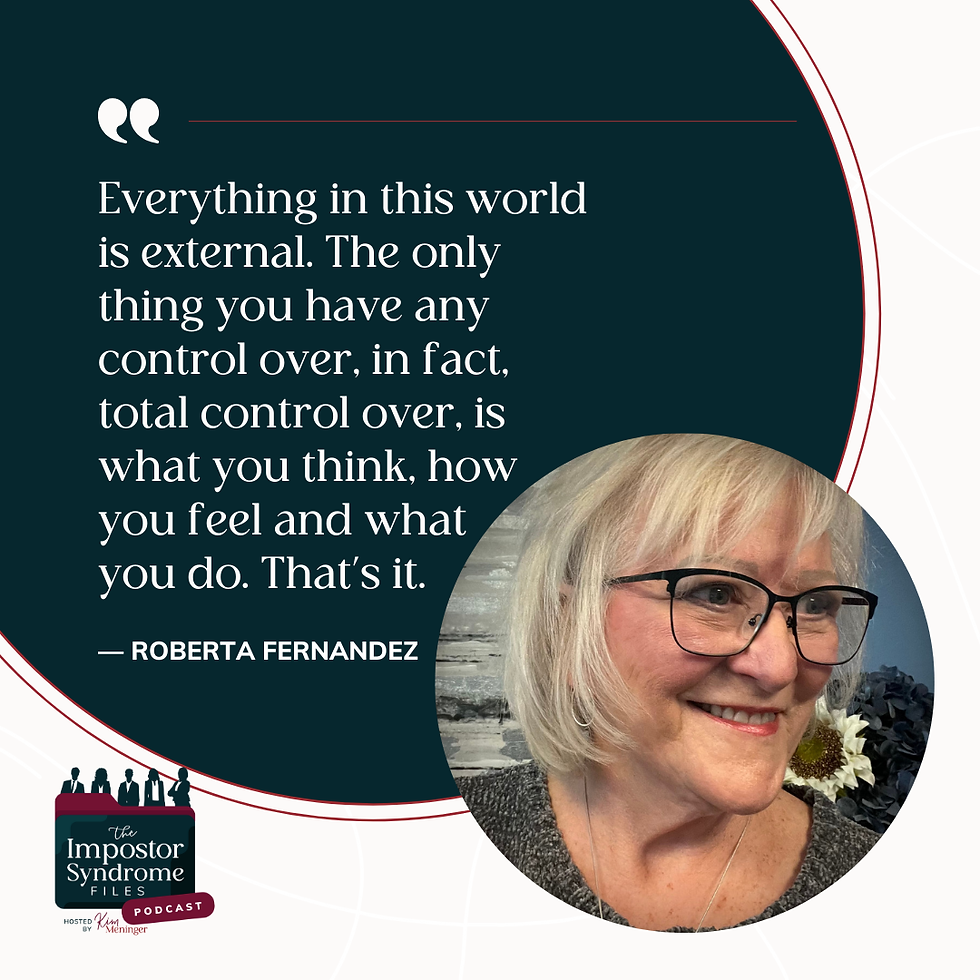
I think, well, yeah, there's a couple of things. So here's, here's something I love to tell people. So here's, here's something your audience can do, and it's kind of fun, but it's very it's easy, but it's hard. So I call it my alarm challenge, right? And this is just tuning into yourself. So every hour throughout the day, you're going to set an alarm on your phone and a random hour, so maybe 112, and 222, or 313, whatever, just sent a random thing when the alarm goes off, you write down what am I thinking and what am I feeling. Now, that sounds really easy, but I will tell you it is very hard, because we are not used to examining those things. We're not used to tuning in to ourselves like we should. So doing this over the course of a couple of weeks, as much as you can when you journal it and you go back, you're going to start seeing patterns of thoughts and behavior. You're going to start seeing change over time, because this will become easier, but it is a very simple, basic way of starting to tune in to yourself and what's happening at any given minute during your day. And it is enlightening. Let me tell you. I do this with all my students, and they just, the results are hilarious, because they'll come back the next week and go, I'm just like, I failed at all of this. I couldn't tune in, like, I don't know, I don't know what I was feeling. And it's like, yeah, that's exactly my point, right? So, and then the second step of this is, are those things congruent? In other words, are your thoughts in alignment with what you're feeling? And then take it the third step, are they in alignment with your actions? Because here's the advice I have to your audience, everything in this world is external. The only thing you have any control over, in fact, total control over, is what you think, how you feel and what you do. That's it. That's the only thing you have control of. And here's the other thing, the flip side of that, no one can take that from you, and no one can make you think, feel or do anything, unless you succumb to that, unless you choose that. We like to say, Oh, you made me feel angry, or you made me cry. No, they didn't. You allowed that. You chose that because we always have a choice to think, feel and do differently than what we do. May not be an easy thing, but we always have that choice. And so when we can start becoming aware of that, what are we thinking, what are we feeling, what are we doing in any given moment? That is when you start to take back control over your life.
Kim Meninger
That is so powerful and such a great, I know, simple but challenging exercise, right? Such a great tip for people who are just starting this, this work. I could talk to you all day. Roberta, in the interest of time, I want to ask you where people can find you if they want more, more of you and your work.
Roberta Fernandez
Yes, so you can find me at Roberta, at Roberta Fernandez dot com that's my consulting website, and you can reach out to me at that email address, or just Roberta Fernandez dot com go check out some of my stuff. I have several assessments Emotional Intelligence and Syndrome Culture, if you're interested in it, for yourself or for others, I think maybe the best way, because I don't want to overload you, Kim, is just email me for any of those things. I'm happy to send them to you and take it if you want to call me back. I offer a 30-minute Strategy Session free. It's kind of my personal mission in life. At this point, you know, I'm in my last third so it's like, what's going to be my legacy? What am I going to give? Right? And this is something that I can give to everybody. So you know, if it's, if it's an area that you think you need to work on, definitely reach out to me. And I will also give you one more thing, if you don't mind. [Sure.] And that is, that is something that is, this is a very powerful hypnotic suggestion. It's not an affirmation. There's a difference. Affirmations can be very destructive. Quite honestly, if you don't buy into them, it has to be something that's believable to you in order to be effective. But the, the affirmation, or the what we call an auto-suggestion, which is a hypnotic suggestion, because the most powerful suggestions that you get are the ones you give to yourself. Every day, this is what I would like your audience to say to each other to get up in the morning, or even before they get out of bed, when they just waking up, to say to themselves every day, In every way, I'm getting better and better. Every word of that sentence is very specific and powerful. Every day in every way I'm getting better and better. And what I know about your subconscious mind is that it will interpret it in exactly the way you need it at that moment.
Kim Meninger
I’m going to write that down for myself too. Thank you so much for, for all of you. Yes, I mean, this has just been such a pleasure, and selfishly, it's been really fascinating to me personally, too. So thank you so much for being here and for the work you're doing.
Roberta Fernandez
Thanks for having me, Kim. It's been a pleasure and, and I hope I hear from your audience, because I'm happy to share.


