
Confidence Via Connection

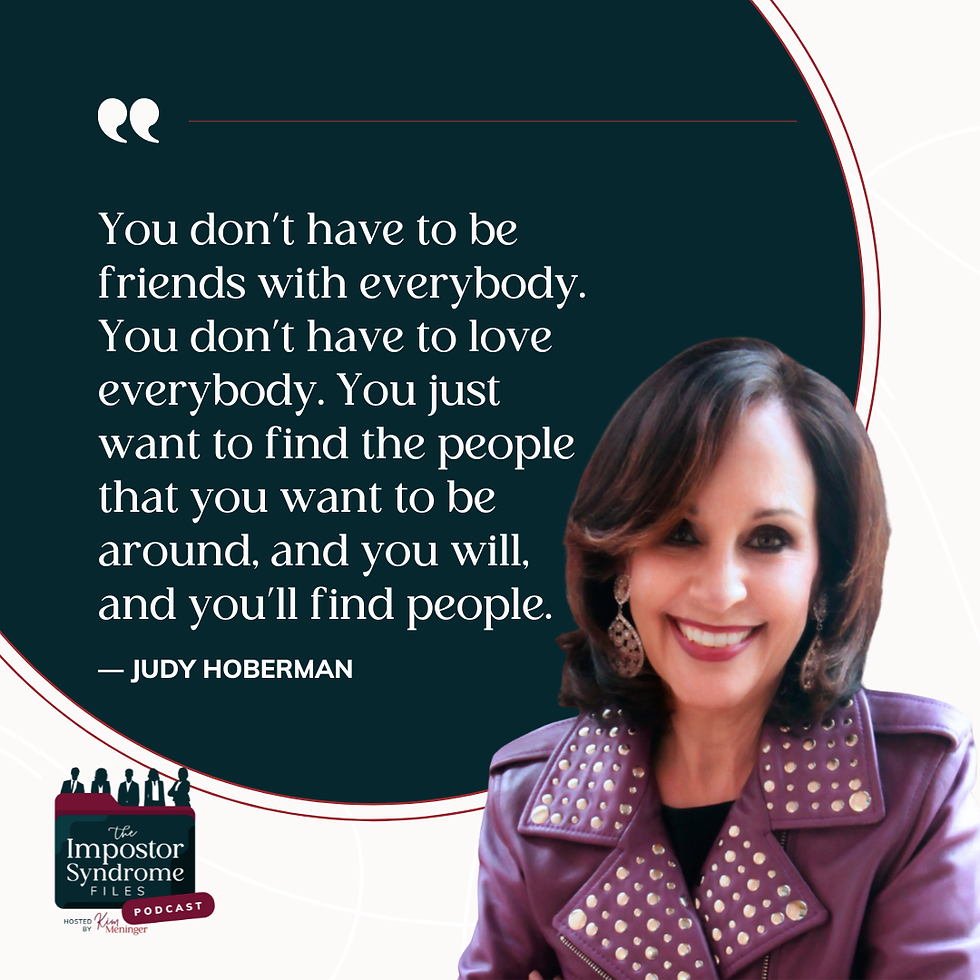
In this episode of The Impostor Syndrome Files, we explore what it really means to lead with authenticity in a world that doesn’t always welcome it. My guest this week is Judy Hoberman, a trailblazing executive coach, speaker and author who built her career in male-dominated industries like commercial roofing and financial services. Judy shares stories from her early days climbing ladders in skirts, navigating bias and building unexpected alliances, and how those experiences shaped her belief that relationships are at the heart of everything.
Together, we talk about how the leadership landscape has changed and how it hasn’t. Judy and I explore the loneliness of leadership, the complicated dynamics among women in the workplace and the ongoing tension between showing confidence and being labeled as too much. Judy also offers practical, encouraging advice on how to build a network (even as an introvert), how to start authentic conversations and how to lead from a place of generosity instead of fear.
About My Guest
Judy Hoberman is President of Judy Hoberman and Associates, a company focused on empowering professional women. She is an award-winning international speaker, best-selling author, trainer, and leading authority on women in leadership and sales. She is also a Certified High Performance Coach™ where changing your habits can change your life. Her focus is on Executive Coaching and Trailblazer Masterminds for women. This direction is where her true passion is and gives her the time and attention to work with these incredible women, primarily in financial services and healthcare, which has always been part of her mission and vision.
Judy’s 30 years in business along with her experience in sales and leadership has helped her clients realize the importance of building relationships, standing out and being the authority in their market. She is often described as “transformational.”
She is a best-selling author, a TEDx speaker and the host of The Trailblazer Chronicles podcast.
Judy’s mission…to help one woman a day by following an important philosophy- "Women Want To Be Treated Equally...Not Identically"®
~
Connect with Judy:
Website: https://sellinginaskirt.com/
Instagram: https://www.instagram.com/sellinginaskirt/
Facebook: https://www.facebook.com/sellinginaskirt
~
Connect with Kim and The Impostor Syndrome Files:
Join the free Impostor Syndrome Challenge.
Learn more about the Leading Humans discussion group
Join the Slack channel to learn from, connect with and support other professionals.
Schedule time to speak with Kim Meninger directly about your questions/challenges.
Websites: https://kimmeninger.com
Transcript
Kim Meninger
Welcome, Judy, it's so great to have this conversation today. I'd love to start by inviting you to tell us a little bit about yourself.
Judy Hoberman
Oh, I don't know where to start. Kim. So that really, I guess you know, when I first started out, I I was in commercial roofing. I couldn't even think where I was. I was. I was in commercial roofing, and it was a very interesting time for me, because it really showed me how people respected you or did not respect you. And so I was, I was told back then that the only thing I needed to do was basically show up, because I was going to be selling commercial roofing, but I knew nothing about it, and they wouldn't train me, and it was in the 70s, and they said, you know, you just have to dress the part. So you always have to wear a skirt. You know, it was the 70s, and I remember the very first day where I was going on the roof, I'm climbing a ladder in my skirt, and I have all these roofers and management underneath me, and they're all giggling, and I'm thinking, oh my god, like, what am I going to wear the next day that underneath my skirt so they could all laugh at me. But it was a very big learning experience, because what turned out was the management was really they just wanted to be the face of the company and bring business in, but the roofers were my protectors. They told me, you know, not nobody's going to hurt you, nobody's going to bother you, we will take care of you. And it was about the relationships. And I say that because, you know, in sales is all about relationships. Business is all about relationships. And I had, like, a group of roofers around me that were taking care of me. Fast forward a couple of decades, and I ended up in financial services, all about relationships. So just kept, you know, relationships kept traveling with me, and I did financial services for quite a long time. Did very well in it. Didn't know anything about that either. But when I left, they had put me in the corporate side briefly, and it was like no. But when I left, I remember thinking, what was I missing throughout my entire career? And I was missing somebody that understood someone like me. I was a single mom, I was female, I you know, I was all of these things that checked off boxes now, but I checked off boxes before they existed. And so when I left, I thought, I really wish I would have had someone like me. And then I went, I'm supposed to do this. This is who I'm supposed to be. I became that person that I wish I would have had, and I do that for a lot of other women. So I'm an executive coach. I do masterminds for women, I do leadership and sales training, I'm a speaker, I'm a coach, I'm all that kind of stuff, but I really majorly focus on women and helping them build relationships and giving them the tools that they need to be successful. That was a long story, long.
Kim Meninger
That was great. No, I love, you know, sort of hearing the arc of your career and how you got to where you are today. And I'm curious, when you talk to women today, how much has changed and how much has stayed the same, right? Are you? Are you hearing similar themes to what you experienced in your own career? Or are you seeing…
Judy Hoberman
Yes and no, yes and no. It really, first of all, it depends on who it is. If you talk to somebody that is, you know, young, they have never experienced the problems that women had with each other, you know, like, I've already done this myself, and I don't want to help you. And, you know, women are territorial. They never, they never had that, and they also never had the male-female challenge. On the flip side, you know, when you're talking to, you know, most of my clients are probably, you know, 40s, 50s, 60s, that they all know about this, they and they felt it, and they're still feeling it so as much as we say, you know, we've come a long way, and we have, we have a lot, we still have a lot of work to do, because you still have the same challenges where you're not being taken seriously, or imposter syndrome, or any of those things that we didn't talk about then, that we were allowed to, I'm using air quotes. Talk about them now. You never talked about being confident. You would never do that, because then people would think you're not, and you'd never talk about, you know, being bold, because then they have a different b word for you. So it's very different. So it's very different, but it's also very much the same.
Kim Meninger
So I wonder if you can talk a little bit more about the relationship piece, because what you said about the roofers is really interesting. And I think you know finding your support systems wherever you are, is so critical to navigating the workplace. And, so can you say more about how you recommend women maybe who struggle with that should think about relationships in the workplace?
Judy Hoberman
I think the first thing you have to remember is you have to know your people. And when I say that, it doesn't mean that you have to have a team of people. You have to know your people around you. You have to know your people who are the ones that are going to support you, who are the ones that are going to hold you back, who are the ones that you know you can count on. And. And even if you don't really know how to do it, it's, it's really more about people that you come in contact with. I always tell my clients, you need to build your relationships before you need them, because when you need them, it's usually too late. You know, if I said today that I don't want to do what I'm doing anymore, I have enough people that I can say, Okay, who do you know? And they would tell me, if you don't have anybody in your network, start even when you're not looking for anything, even when you're not go to a networking event. Meet a few people. You know, I'm an introvert, so for me to tell you to go to a networking event is, you know, funny, because it's not something that I love to do. I'm better now, but I can remember when I first started my company, I would stand at the door of a networking event, look at it, and I would absolutely freeze because I didn't want to walk into some place. I didn't know anyone. But then how do you meet people if you don't walk in? Right? So after the first one, which was just a horror show. I just sat there with someone I didn't know. We didn't speak. We didn't talk at all. We didn't introduce ourselves, we didn't swap cards. And I got in the car and I went, whoop. I just networked, which was the biggest joke in the world. What I found out, though, is, if I showed up early to an event, and I always, I always show up early, but if I was there, you know, 15 minutes to 30 minutes early, and I'm the first one there. Guess what happens? Somebody walks up to you first. You don't have to walk up to them. So women that don't have a network and don't really know how to do it, go someplace early, and you will find people will come right up to you and say, Hey, my name is Judy. What's yours? And it just takes down the pressure. But you really, really, really have to think about creating the relationships around you. And it starts with just a simple hello, just a hello. That's all you have to do. And it starts you don't have to be friends with everybody. You don't have to love everybody. You just want to find the people that you want to be around, and you will, and you'll find people. I mean, I see people that when I when I'm in front of them, I take a step backwards because I don't like their energy. So I know those are not my people. Nope. So it's things like that.
Kim Meninger
Yeah. Well, and I like the tip too, about going early, because that is uncomfortable for a lot of people. And I'm extrovert, and I still find it uncomfortable sometimes, and so setting yourself up for success in those types of environments is really important. Another tip that I often recommend is look for the person who feels more uncomfortable than you do.
Judy Hoberman
Doesn't always work, but a lot of times it does. A lot of times it does because it makes you feel like the expert.
Kim Meninger
Yeah, exactly, exactly. And I wonder too, because sometimes people are afraid. You talked about the fact that it wasn't okay years ago to talk about confidence, or to talk about, you know, imposter syndrome, and things like that. There's, there are sort of mixed messages these days. I think there's more of a push for vulnerability and kind of share more openly with each other. But then I still hear from women who are afraid that if they share vulnerably, it will be used against them. They're not sure how much they can trust people, right?
Judy Hoberman
Yeah, and that's what I'm saying, I mean, things have changed. Things have not changed. But you also have to figure out, like where you are. And one of the things I talk about is the lonely leader. And as you go higher up through the ranks, and you know, you have these big jobs or whatever, it gets lonely. You don't know who you can talk to. You don't know you could trust. You don't know who has an agenda, who doesn't have an agenda. You don't know how they're going to take your stuff and you and, and, you know, send it up. And so you're out of the picture. You don't know that. And that's why you know you have to reach out and trust people and or or meet people and then decide if you trust them or not. But that's why, you know, I always tell people, have, you have to have a coach. You have to have a coach. Coaching is, you know, a lot of people say, well, I shouldn't have a coach because I'm doing really well. I don't even know what that means you're doing well. So you don't need a coach. Elite athletes have coaches. They're doing really well. But a lot of people think it's punitive, especially if you're in corporate and they give you a coach. Now there's you're thinking, Oh, I didn't do something. Well, I'll never get advanced, and all of that nonsense. But the truth is, a coach is somebody you can trust, so, you know, and it's somebody that will give you the right things to, you know, the strategies, the ideas. So sometimes it's that, that you have to do, but a lot of times, you know, you're working with people, and you don't know, you know, how much can I tell them? Because I really don't want them to think I'm weak or, you know, I have no confidence. So it's a very it is, it's mixed messages, it's, it's definitely mixed messages.
Kim Meninger
Yeah, and I, I wonder, too, going back to what you were saying about maybe the younger. Generation of women hasn't experienced the, the conflict with other women, and I think that is still a big part of what a number of my clients face and it sounds like yours too. [Yeah.] Do you have thoughts on how to navigate those kind of dynamics? If you feel like there's either competition or some resentment there, that, that sort of women not supporting each other in the workplace.
Judy Hoberman
Yeah, you know. And it is. It's very interesting to me, why women will say, look, I had to do this all by myself. And why shouldn't you have to do it by yourself? It builds character. Well, it might. And you know, but why are we making it harder for the next generation? Why are we doing that? And I still don't get that. And every time I hear somebody saying that they're struggling with that, I still don't understand why women are very territorial, whether it's personally or professionally they are. And if you saw somebody that was younger than you, you might be threatened by them. Somebody that was smarter than you, you could be threatened by them. And so instead of helping them you, you push them away. I always say, you know, if there's somebody that you would like to know more about, or you want to figure out why they're doing what they're doing in the way that they're doing it, have a conversation with them. You don't have to say, okay, Kim, so tell me why you're mean to me. You don't have to talk about that. Tell them something that you admire about them. It could be the smallest little thing I love the way you do X, can you show me how to do it? Can you tell me how you got started? I'd love to know more about you. If they still put the wall up. They're not your people. They're just not your people. So you be professional and you do what you have to do. But many times they're in the same boat you're in. They don't know if you want to be friends with them or like them, or you know, you don't know. How do you know? Because people put up this facade. They're just as nervous and scared as everything that we feel. They just hide it better.
Kim Meninger
Yes, that's a great point, because that kind of behavior is a sign of insecurity, right? Totally, yeah, not confident behavior. And so like you said, you may put some effort into it and uncover that the person really can't be trusted, and there isn't a lot of point in continuing. But I think it's good leadership to be the one to take that step and to, you know, to, to reach out to somebody the, the olive branch, so to speak, right, like you said, and just show curiosity, show interest in the other person. And you might be surprised by how they are.
Judy Hoberman
I would say, be interested in someone, not be interesting to them. So being interested in, interested in them means you're going to ask some questions. You're going to be curious. You're not interrogating. No, I have been dubbed the question queen, and a lot of times when that, when I was in the financial services if I would walk into a room, you would absolutely see people rolling their eyes when I walk in, because they know I was going to ask them a lot of questions, and people are uncomfortable with that. But it wasn't questions, you know, about, you know, name, rank and serial number. It wasn't those kind of questions. It was about letting me know something that was interesting about them. So when I used to recruit people, I would say, tell me something that's that you're proud of, that's not on your resume? Now that's a loaded question, because, you know, people are I'm so I just worked on my resume. It's amazing. I know it's great. I can read it now. Tell me something you're proud of. And it was so interesting, things that people would tell me, things that they probably didn't say out loud before, but I was interested in them. When I got married to the Colonel his, his older daughter said to me, before we got married, why do you ask him so many questions? You know, he was a Colonel like I know, but I'm interested, and if I stop asking questions, that's when you should be worried. She's never asked me that question again, because that's the truth I want to know about you. Tell me why you do this. How did you get started? I want to know everything. I can't do that in one sitting, so I build a relationship with you, and then I might ask you a question, or I might ask you 10 questions. I don't know, but it just depends on how it, how it works, but it's really important to let people know that you want to know more about them. Why, you know? When did you get into this role? This is, like, an amazing role. How did you do that? You know, anything that you can start with, or you see a picture on the wall and they have a dog, and he's like, Oh, I love that. What kind of dog is it? Okay, you just broke the ice. So it's anything that you can start the conversation with. And you ask, you know, open-ended questions, because it makes them, gives them the opportunity to speak.
Kim Meninger
Well, and I I love this because I have always joked that people love to talk about themselves, right? And I think that there's a lot of pressure that we put on ourselves to, like you said, Be interesting, so I'm trying to prepare. My responses to the questions you might ask me, as opposed to really showing genuine curiosity in another person. And if you think about it as what am I going to ask this person, how am I going to show my interest in that? That's a much easier conversation to have than treating it like you're in, you're in in an interview, right?
Judy Hoberman
And it's true. You know, you just you. Your guard goes down, you can breathe. You're not so stressed. And I think a lot of times, women don't know what to do in a conversation. What do you talk about? You know, a lot of women will say, I don't want to talk about my personal life, because this is business. Well, they do overlap in some way. They do overlap. Maybe you work with your spouse. Maybe your kids are, you know, they're going to be what you are, whether it's a financial services or a doctor or whatever it because it does intersect. You don't have to tell them what color you're, you know, your car is, or where, where you live. You don't have to give any information like that. But if I said to you, oh, that's that looking through your window. It's gorgeous there, tell me about where you live. You know what I mean? That would be very different than me saying, Okay, so tell me this, tell me that, because it doesn't mean anything, but that would be of interest, because you're proud of where you live, and that's a beautiful area, you know.
Kim Meninger
Yeah, and I wonder if you see, I mean, we both probably work primarily with women, but it was my experience in my previous work life, in high tech. And I know you've worked with lots of men, too. I think that they socialize differently, yes, and I think that's important to acknowledge as well, and, and I think it goes back to some of the things that you were talking about, too, trust and insecurity, but also, women are really busy, and if we feel like, Oh God, I don't have time for chit chat. I've got to get the work done so I can get home and do the second job of taking care of my kids, and I, you know, I'm the chauffeur for all my kids stuff. And so it almost feels like a luxury we can't afford. But so much of the influence that we build right is rooted in these social conversations and connections that we have with other people.
Judy Hoberman
But you don't have to make it, as you know, a third job, you don't have to do that either, but you can, you know, carve out time on your calendar like anything else, and say, I'm going to meet people you know, an hour here, an hour there. Go to a networking event, go to some place that you know people congregate, because otherwise you're going to sit in front of your computer. Now, you can still do it on your computer. You can go on to LinkedIn, you can meet people, but it's, it's going to be different. It is going to be different. You just have to decide, like, what's really important. And I mean, I don't want to sit and have 500 new friends. I don't, I don't have time to do that, but I do want to have an impact over people, because I want to be able to give them what they need. I don't care, you know, it's not what I want them to have. I want to know about them. Tell me what you're looking for. What does it look like? And maybe I can help you. But that's the only way to do it, is to really get down into the nitty-gritty. It's funny, when I first really, really, really started working, it was back, you know, when I was in my early 20s and I had a job with Fuller Brush. Do you know Fuller Brush? No, okay, Fuller Brush is true, door-to-door. Oh, true. And you would sell these amazing things like brooms and mops, real sexy things. I don't even know why I got this job. I don't know. Anyway, I decided that the first door I was going to knock on was my mom, because I know her, and she'll buy from me, and it'll start everything off really well, and I have already have a relationship with her. And so I knocked on the door, and she answered the door, and I went through my whole spiel, and she said, Yeah, I don't need it. And I thought, oh my god, this is going to be harder than I thought. And she said, Well, let me just explain something to you. And I never forgot this, and it was, it's all about relationships. She said, Just because someone loves you does not mean they're going to buy from you. That was number one. Number two was just because someone loves you, they're going to share you with their friends, meaning referrals. So, so there's a way to start a relationship. You know, even if and when I sold, you know, financial services, a lot of times I talk people out of buying it from me because they didn't need it, or what they had was better, but I created a relationship with them because I wanted to protect them and not pay me. And people would say to me, didn't you just talk yourself out of this? I would say, Yeah, but I know you have what you have is better, or you don't. This is not what you need, and I'll find somebody that has what you need. And I started building those relationships. And one by one, you know, they would start giving me referrals, because they would say she actually listened to us. She didn't push anything on us. She was very easy to talk to. She explained everything. Those are great things to hear, and that's how the relationships were built.
Kim Meninger
Yeah. I mean, that's so powerful, too, because what you're really talking about is you're building trust and credibility in a way that allows other people to essentially be ambassadors for you, right? Because they know that you're, you're doing what's right for the person. You're not just out there for your own self-interest.
Judy Hoberman
Yeah, yeah. And, you know, I always said, If I could just connect people, just do that and do nothing else, I would love it. But my mortgage company says, Yeah, I don't know. Utilities are going, Yeah, I'm not sure about that either. So it's not something you do, but I just do it naturally. I do I just do it naturally because I really want people to do better. I want my, my mission has always been to help one woman a day. And of course, people will say to me, what about 100 women a day? No, no. One woman a day, exponentially, is a lot of women. But if I could do that, if I can change something for you today, then you're my woman. And when I do it, you know, when I talk about it, when I'm speaking, there's always a woman that will come, come over to me and say, Can I be your woman today? That's very humbling. It really is, but that's how it works. Is because that's how I build relationships. It's about you, it's not about me.
Kim Meninger
Yeah, and that, I think, leads to its own confidence. I'm a big believer that we feel more confident when we're being of service to others, because attention is not on ourselves and how well we're performing, but on other people.
Judy Hoberman
Yeah, totally, that's how it works.
Kim Meninger
Well, and I know you wrote a book, so can you tell us a little bit more about that too?
Judy Hoberman
I actually wrote four.
Kim Meninger
Oh, well, I'm looking at the one that you have…
Judy Hoberman
So this is, this is Walking on the Glass Floor. This is my, the last book I wrote, and it's all about leadership, women in leadership. And it's, it's about the seven qualities of women who lead. However, it's also for men. But I write, you know, my stuff is really geared towards women, but men like it because they, they work with women, they work for women, so they're good with it. But this is all about leadership. These are the seven skills that you may not think of leadership, skills like courage, authenticity, you know, generosity. These are things that I truly believe as a leader, you should be participating in this. So it's Walking on the Glass Floor, and it really means that. Okay, so you've climbed through you've crashed through the ceiling, blah, blah, blah, now you're on the floor. Are you going to tap dance here? You're going to leave, you're going to just try it and leave, or are we going to be able to help you keep where you are and keep your footing? And that's what it is.
Kim Meninger
So tell me more about authenticity in your in your mind. You know, everybody has a different definition of it. And I think this goes back to some of the conversation we were having about vulnerability too, and the sort of fear of putting ourselves out there too much, and what some of that backlash may be, because it's still the case that women are much more likely to experience backlash for stepping out of traditional gender stereotypes and, you know, like you said…
Judy Hoberman
Or just being them, or just being them, yeah, yeah. So for me, authenticity is people should know who's showing up. You know, you shouldn't have like, 12 different personas. It's who you are. I am the same exact person here, if I'm talking on stage, if I'm the same exact person. So who are you? Because people want to know the real you, they don't want to be have to guess, uh Oh, which one is showing up today. Is the mean one is the nice one. So authenticity is just you, be you. That's all you have to do, is just be you. But you have to be comfortable with that also, because, you know, a lot of us are not comfortable in our own skin. We're just not so you have to decide, like, what is it that is really holding you back from being comfortable? And you deal with that part, and that's a whole other issue. But I just think authenticity is simple as who you are, how you show up, how people perceive you and how they see you, because perception is reality. And I say that because I have been perceived as being intimidating, unapproachable and out of someone's league. And I've had that mentioned to be by many, many people, and the reason is because I'm an introvert and because I have like a force field around me, I don't invite you in. You have to, like, crash it down. But if you take the time to do that, you'll, you'll like me. But if you don't, then you have this, Oh, she's so intimidating. And I'm not intimidating whatsoever. It's just but perception is reality. So I do my very best to when I show up, this is who I am. And if you know I'm an introvert, you might just pull me in, and then I'm fine.
Kim Meninger
Do you share that? I think this is a really important point, because I know a lot of introverts, and there is oftentimes a misconception that they're aloof or maybe interested in connecting. I think part of the challenge with, with an with introverts, is that if, if an ex-, like an extrovert, is kind of talking, and everything's out there in the open and there isn't as much mystery, whereas if an introverts being quiet, we're projecting on to them, where's our making up stories about what's going through their heads and why they're behaving the way they are and, and oftentimes, if we're insecure, the story we're making up is not favorable to either one of us, right? And so I wonder, do you, as it relates to authenticity, do you feel comfortable telling people that you're an introvert? Do you feel comfortable saying, you know, I…
Judy Hoberman
100%. 100% in fact, you know, a lot of times when I talk about what makes you unique, I always tell the story about when I first started my company, I knew nobody. I live in Dallas. I was I was relocated here. I left the company I was working with. So who am I going to network with? The only people I knew because I traveled so much were the people I just resigned from. That's not networking, right? You can't do that. And so I started speaking everywhere. I didn't care where it was. It didn't matter to me. I just had to get out there. Remember, I'm an introvert, but if I'm speaking, I can just be me on stage, same thing, same person. Anyway, I kept telling my coach that nobody talks to me until I come off stage, not one person will ever speak to me. And she said to me, Don't forget you're an introvert like I can't forget that, but it's still not comfortable. So I did this informal survey, and I asked people separately and many different events, I would say, what three words, how would you describe me? And that's how they would describe me, intimidating, unapproachable, and out of our league, till I came off stage and they realized it wasn't like I was pushing them away. It was just, I'm an introvert. And so after it happened, like three days in a row, I, you know, I said I have to do something, and I couldn't figure out what to do. So I went to another speaking engagement, and I was wearing a pair of sparkly boots. And I always wear boots. I don't care what season it is, I wear boots. And this woman came up to me and she said, I love your boots. And the first thing I had to think of was, Have I already spoken on stage? Because somebody's talking to me. That was the first thing I thought of. And so I thanked her and everything. And then another woman and another woman, another woman. The next day I spoke somewhere else wore the boots. Same thing happened. Third day. I thought, I am going to be an athlete. Now athletes winning, they don't change their underwear. I'm not changing my boots. And so boots became and I told my, my coach this, and she said, Well, maybe that was your icebreaker. So boots became part of my brand. So now, wherever I go, you know, if somebody says something about my boots, I'm going, okay, it still works. I'm good. That still works, but, but that's how I know what it's like. You know, if you're if you're trying to meet people, if you're trying not to be the introvert, if you're whatever you're doing, I don't know how to do an icebreaker otherwise. And other than, you know, showing up early, that was, that's my other icebreaker. But to me, it was a learning experience for me. It really was.
Kim Meninger
Yeah, well, I love that story too, because that's an authentic expression of your personality. Those boots too, right?
Judy Hoberman
Right, but it just goes to show that I'm not afraid to tell this. I tell the story all the time, and people just laugh, and they look at me, oh, you're an introvert. Because here as a, as a speaker, how can you be an introvert? It's very easy. It's very easy. You just talk to yourself before I get on stage, and you're good. But I have no problem telling people I'm an introvert or anything else. I mean, I will tell them stories about me I was, I will always say to the, the person that brings me in, don't even read my bio. By the time we're done, you'll know all about me anyway.
Kim Meninger
Yeah, and I really, I really appreciate that approach because I always joke that if there's information missing, we will make it up, right?
Judy Hoberman
That’s right. There's nothing to make up with me. There really is. I got nothing.
Kim Meninger
And people feel more connected to you, the more they know about you, right? Yeah, so I think that's, that's, that's a really great tip. I am so grateful to have you here, Judy and I know there's so much more where this came from. We're just scratching the surface here. In our short time together, you've written four books. You do this for your job. Where can people find you if they want to learn more about you and your work?
Judy Hoberman
You can either go to LinkedIn and under Judy Hoberman, or go to my website, which is selling in a skirt dot com. And that's my company, and you can find everything you want on either place or both places.
Kim Meninger
Wonderful. I'll make sure those links are in the show notes. And thank you so much for being here.
Judy Hoberman
You’re so welcome. And thanks for having me.


