
Rewriting the Stories that Hold Us Back

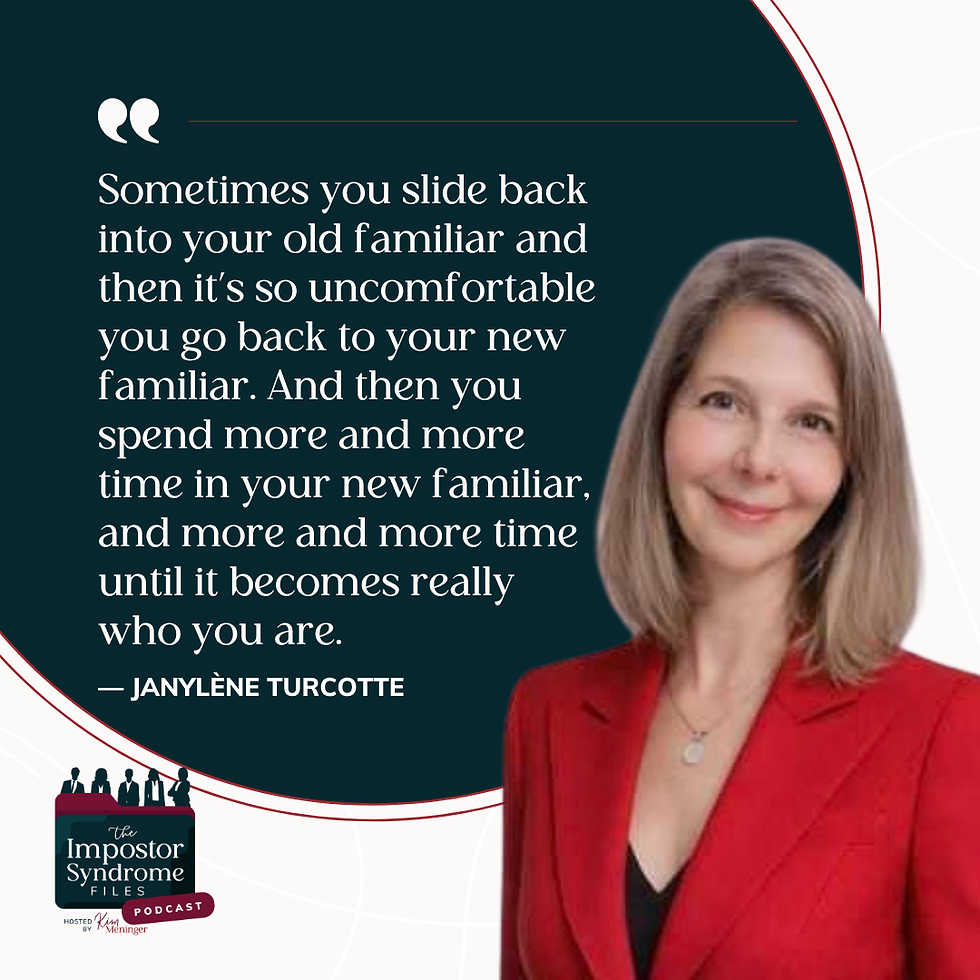
In this episode of the Impostor Syndrome Files, we explore how deeply held beliefs can shape the way we see ourselves and what we believe is possible. My guest this week is Janylène Turcotte, a hypnotherapist, hypno coach and executive coach who helps professionals move through limiting beliefs and self-doubt.
Janylène shares how an unexpected career transition led her to reconsider what she wanted and eventually discover hypnotherapy. We explore what hypno coaching actually involves, why it’s different from the dramatic versions of hypnosis we see on television and how it can help us access perspectives that are often drowned out by our inner critic.
We also discuss the beliefs that commonly fuel impostor syndrome, including the fear that others are better or will judge us. Janylène explains how changing those beliefs can lead to surprising shifts in our behavior and why real transformation doesn’t always happen in a straight line.
About My Guest
Janylène Turcotte is the founder of Hypnocoach and a clinical hypnotherapist who has guided 1,500+ one-on-one sessions. After 25 years as a senior HR executive — the last eight at Deloitte — she now works with founders and senior leaders through the identity shifts a résumé never prepares you for: selling a business, an ending that came on someone else's terms, reinventing after the title is gone. Her method, Peel Back · Rewire · Rise, works on the belief underneath the behavior. Practical, not mystical.
~
Connect with Janylène:
Website: https://hypnocoach.ca
Booking: https://link.hypnocoach.ca/widget/bookings/janylene-turcotte-personal-calendar-yqnwtklhsshegli
~
Connect with Kim and The Impostor Syndrome Files:
Join the free Impostor Syndrome Challenge.
Learn more about the Leading Humans discussion group
Join the Slack channel to learn from, connect with and support other professionals.
Schedule time to speak with Kim Meninger directly about your questions/challenges.
Websites: https://kimmeninger.com
Transcript
Kim Meninger
Welcome, Janylène. It's great to have you here today. I'd love to start by inviting you to tell us a little bit about yourself.
Janylène Turcotte
Thank you, Kim, for inviting me. My name is Janylène Turcotte. I'm a hypnotherapist, hypno coach. I'm an executive coach. Basically, I do help professional leaders, Entrepreneurs to go through transitions, transformations, a certain blockage, and that's what that's what I do. And have you always done this? No, I come from the corporate world, so where I spent 25 years, kind of had two careers before one in sales, so sold encyclopedia door to door, led sales team, and then started in HR. And I think one thread in my career is is been you don't have what it takes on paper. You're not graduated yet. You don't you know you don't have the experience, let's say, to merge two law firms, but we we we're confident you can do it, and so and so I had a lot of people giving me chances, believing in me even though on paper I didn't have what it takes what it took at the time. So I think that's a big thread in my career, and then eventually my career ended in the corporate world by not because I decided to. There was a restructuring, and from there on, I went onto a path of recovery from alcohol and also discovery of myself. And eventually, found, if no coaching, I was already a coach. Found if no therapy, and said, "This is what I want to do for the rest of my life, and here I am.
Kim Meninger
Wow, that's a that's a really interesting career arc, and I always appreciate when things aren't linear because I think a lot of times we assume that people have their careers figured out in advance, and that there's like you know one right way to do it, and so I love that you have taken these twists and turns to get to where you feel like you really want to be.
Janylène Turcotte
Yeah, yeah. I think it's always about looking at what you where you are. All you can use what you already have and bring it into the next career. Be curious, and also, you know, has in the Joari windows. You know, sometimes people see things in you that you don't see, you know, for yourself. And I always say it's good to listen. It doesn't mean that because they see it in you that it's relevant or it's useful, or it's even true, but it's okay to look at it and consider it and pondering it and say, okay, is this does that have any value? Would that could this be a path for me? Like the entrepreneur path, is this a path I've never thought I would take? But so many people in my career, told me, "Oh, you should have your business. You should have your business. You should have your business, and I was like, "Oh no, I love my security too much for that. When my security got kind of taken away from me in a certain way, I then reconsidered the question because it had been presented to me so many times, and I started to see that the security or the golden cage was just was no longer there. So could I consider now what people have seen in me that I didn't see?
Kim Meninger
That's a really good point. I think on a couple of fronts is looking at what other people are telling you as data, right? It's not necessarily a fact, but it's worth looking at and, and thinking about it in the context of how well they know you and how well you trust them, and right. But really, it's it's helpful to have an external perspective, and they like you said. They may see things that you are just too close to the situation to see, right? And I think also there's a way in which we get trapped in fixed mindsets that we don't even realize, and there may be some limiting beliefs, some fears that are driving a lot of the narrative. And so being open to reexamining what that looks like too, of you know how much of this is because I like for example the entrepreneurial one like how much of of the story I tell myself about that is rooted in my values and how much of it is rooted in just a haven't given enough thought or maybe it feels a little intimidating.
Janylène Turcotte
No, even in myself, my family history. Like my father had many careers and different businesses, and we had very unstable incomes, like very good years, very bad years. But he was never into working in a corporate world or having. And I was craving no. How much money I would have every week because I was told all the time. Well, now it's a good time. Yes, you can have those shoes. And now our business is not doing well. You can't have those shoes. And and I didn't want that. I wanted to have the shoes. Yeah. Able to know what kind of shoes I could buy?
Kim Meninger
That's very true. Yeah. So, so tell me more. First of all, I'd love to hear what is hypno coaching. How would you define it? And what do you help people with?
Janylène Turcotte
Okay. So I'm an ICF certified coach. I did my coaching at a management coaching school, and then later on, 10 years, maybe not 10 years, seven, eight years after, I stepped into hypnotherapy. I became a hypnotherapist. That's a that's a big story, but I became eventually a hypnotherapist, and, and I kind of saw three things. So I saw my career as an executive, my coaching credentials and experience, and hypnotherapy at the same time. So basically, it's coaching, but under hypnosis. So it's coaching, coaching in that state where you are highly focused, in that state where you don't hear the voices telling you you're not good enough, it's not going to happen to you. You've tried it all yet already, it didn't work, or all the you know negative self thoughts and, and self you know things like I'm not good enough. If people discover me, you know, discover where I am, they they they won't want to be with me. They won't like me. The self-doubt, the being afraid of judgment. People are going to judge me. All this noise. When you're under, you lower it to a level where you can see other things, where you can hear other things, where you can connect to your strengths, where you can connect to your what I call the unconscious richness, like everything that is so rich is inside inside of you that you don't necessarily you either you're not connected to it, either you've lost sight of it because of life, because of we've told you that this is not good, or this you should think this way, and this and that. So, so that's it. And I really help people that are transitioning, or people have a specific issue like public speaking. Like I have a lot of people who don't take certain positions, or don't apply for certain role, or get stuck in a career level because they don't want to do public speaking, so they will come to me, and I will really help them. Or they have this new role, and they know they're going to have to speak in public. So it could be public speaking, could be anxiety symptoms, could be redefinition of a purpose loss. I work a lot with people who sell their business, who kind of lose sight of their purpose? They're going through the due diligence. They're very tired. Emptiness, being lonely at the top, procrastination, all kinds of things. It's really about going into the going in and inside and finding what are the limiting beliefs, what are the stories, what is what are the narratives that I'm not even conscious that I'm telling myself that are standing in the way, and the three steps is really, you know, peel back, which is find those beliefs, you know, rewire for whatever you want, and then rise and impact people. Impact. How do you want to impact? So, those are the three steps.
Kim Meninger
And you know, I I think that there are some probably misconceptions or just ideas about what hypnosis is based on just the general culture and TV and movies and things like that. Do you have any advice or thoughts for people who may be thinking that that's scary or that they don't want to give up control or you know sort of worried about what?
Janylène Turcotte
I would say start by learning self hypnosis. It's a very practical, you know, easy access tool. I'm sure there's a lot of online free self hypnosis guidance. I do give self hypnosis courses to my clients so they can use it for themselves. That's the first thing. The second thing is, is hypnosis is a natural state. It's not like in the show where you go there and you raise your hand because you know something's going to happen, so you already say yes. You already know that something that you know. You're already saying yes to whatever's going to happen, and they check out for people. They know which one are more influencible and everything. But the type of hypnosis that we do is really more. The one when you watch a movie and you get lost in a movie and you realize that oh my god where was I or you drive from a place to another and you suddenly like oh how did I get here you know it's kind of that state where you are extremely calm your hyper vigilance is low as low as possible, and you can start to really focus, narrow focus on one thing. One thing you ask your subconscious brain, like, open me that box where the key is to be able to speak in public and feel confident, and then under hypnosis, we role play. So for the subconscious brain, it kind of already happened. It starts to be familiar. So we practice speaking in front of people, feeling confident, happy. Voice is clear. I stand. I'm so solid. People are smiling. People are going to the bathroom and I'm totally indifferent. They look at their phone. I'm indifferent and I'm happy to be there. And at the end, they all tell me how fantastic it was, because you've already done it under hypnosis. It's already happened for your brain, who doesn't make the difference between what you imagine and the reality. So it becomes familiar. You have a very, I would say, safe place to create a new familiar to create new neuropath. So that's really what we do.
Kim Meninger
That is really interesting. I think there's something really fascinating from a neuroscience perspective on how the brain treats imagination as memory.
Janylène Turcotte
Exactly. Exactly. Exactly. Exactly. And and it's it's it's fascinating how public speaking is a fantastic example how people very rapidly they see the difference and they're like wow, I can't believe I did that presentation right. And in each session, I will do a recording for people and they listen to it every day, you know, for you know two three weeks, and so the brain learns by repetition, right? So they hear every day how they love it, and it becomes a reality.
Kim Meninger
Is there anything that people need to think about doing either beforehand or during to best experience the process. Is there is there anything that could sort of make the process less effective?
Janylène Turcotte
It's always you know like any type of human to human approach is really about the relationship. It's about the alliance with the coach that you're having, or the hypnotherapist or the hypno coach, I think that's the first. You know, if you don't feel comfortable with the person, if your nervous system doesn't react positively to the interaction, just find somebody else. I would say that's the first. That's the first thing, right? The second things is sometimes you need to give it time. So I have clients. My clients are they're all like people listening to your show, you know, smart people, career people, and then sometimes they say, "Oh, the first time I was kind of watching, like observing what was happening, so I was not really letting go because I was observing, right? And as we go, as the sessions in my my my basic program is five sessions. So when we are the third session, people forget about it. They're used to it now, and they've listened to the recording every day. So they're kind of in the mood of going there by themselves. They practice self hypnosis. It's become like just a calm state where I can find my answers, where I can, you know, feel my value, where I can really see who I am, and I can get easily answers to questions I'm asking myself. So.
Kim Meninger
So you mentioned self hypnosis, and it sounds like there's a lot of transferability if you go through this process for public speaking and you learn how to get into this space that you could then use it going forward for other types of challenges.
Janylène Turcotte
Absolutely, absolutely. Yeah, that my clients sometimes they say, "Oh, you know, Jenilyn, I think about our sessions. I close my eyes and I get my answers because they say, 'Oh, I hear your questions because I ask a lot of the same questions. And they say, 'Oh, I hear your questions, and then oh, I get my answers.
Kim Meninger
And and do you remember? Like, does the person who's gone through it remembers everything that they've said?
Janylène Turcotte
Yeah, yeah. You remember everything the same way. If you go to a dinner tonight, you know, with friends, you will be able to say, "Oh, we talked about this. We talked about that. We talked about this. You you might have epiphany, you know, that you will. Very, you remember, and at the end I always ask. So tell me what's most important when you're still under hypnosis. I'll ask you. So tell me what's most important to you in the session today. What are you taking away? And then I'm going to do the recording on that. So the person is really the, the person's words, the person image, the thing that she gave me or he gave me under the in the session that I do the recording with.
Kim Meninger
Oh, so the recording is your hypnotic process, right? It's not. It's not a recording of the conversation. Okay.
Janylène Turcotte
It's a really. It's a reprogramming, and I've done more than 1500 sessions now, and I haven't done two recordings that are the same. It's really tailor-made to the person in the moment with the energy of the session, so it's highly effective.
Kim Meninger
So for people who are struggling with impostor syndrome, self-doubt, confidence challenges? Do you have to be more specific than that to benefit? Like how how do you narrow down the area?
Janylène Turcotte
Yeah. So, yeah, we go by behavior. I really like to to to ask the subconscious mind very precise questions. So let's say let's take imposter syndrome, and let's say the person says, you know, I, I, I don't know, I, I'm taking this new job, but I don't deserve this. Like I don't feel good about it. Like I don't feel, I don't feel I'm good enough. I'm afraid I'm not going to be able to. I'm to, you know, I'm not going to be able to succeed. Like other, my colleagues are so much better. And if and if they find out who they gave the job to, they you know they will fire me, whatever. So the person will express this like that, right? And then I will say, okay, let's let's find a good question for you know a precise question for your subconscious. What is it that you want? What if this wasn't that, what would that be? And then the person will say, "Well, you know, I would feel confident, or I would feel, you know, I don't know that, you know, that I deserve this this this position, or I would feel competent, or I would feel whatever. So we ask then the subconscious brain, you know, you know what keys does let's say Kim needs to have in order to feel and to know that she is competent. And so this is when we're going to go to place. We're going to tell stories, and then we're going to find the thread that are the beliefs that you have about yourself. It could be others are better. People will judge me. Whatever it is, and then we will transform that limiting beliefs for a healthy belief, for one that you want instead. I am competent, and then we're going to do all kinds of role play where you're going to tell people how competent you are and why you're competent, and you're gonna find we're gonna ask your subconscious brain, okay, bring us to places and time where Kim felt competent, where Kim was competent, and then you're gonna take all those moments that you don't even remember, and we'll re-activate that connection to that sense of competency, or create it. If you say if you can't find a moment where you never you never felt competent because of this and that reason, because you think others are better, then we're gonna undo that belief that others are better. Then we're going to start looking at what is a human being. Let's say our human beings are different. There's so many different components. We can't say one is better than another. Like you know, if you think about it, I always say to people, if you think about a human being like a sound console with all those levers, you know, some people have a high levers on creativity, others on communication, others on physical abilities, and then there's 100 possibilities. How can you say that one human being is superior to another when you have so many variables and so many situations? So you start to see the question differently. You change your perspective on it, and slowly you change your perspective on yourself and on others. And for imposter syndrome, there's often a belief that people will judge me, and I say to people like, "What about you know the judgment belongs to whom judges? When somebody judges you, it informs you about this person. How is this person seeing the world? How is this person sees appreciate?" The world, or you, or something-it talks to you about that person. So we start to shift inside the dialog what you're telling yourself. And so instead of saying people will judge me, you will say, you know, judgment belongs to whom? It judges. It informs me. What does that teach me about those people? And then you start to flip the script, and this is how slowly you know I have people telling me, and it's really funny. Sometimes they say, "Oh, you won't believe it. I asked for a promotion, or you won't believe it. I asked for a raise, or you won't believe it. I did that, and I don't know, you know, this is not what we worked on, but it was kind of the consequences of the work of the shifting of the beliefs that brought them into different actions. So, yeah, I don't know. That's a long answer.
Kim Meninger
No, that's really helpful. Thank you. That is very helpful. And I wonder, you mentioned that there's a fixed number of sessions associated with what you do, and that there is a there's homework involved, right? With people who are listening every day, do people continue to listen after that, or like how how does this stick?
Janylène Turcotte
Yeah, so we really do create new neuropath every time you have a new experience. If you do tomorrow and you start doing a new sport, you will develop new neuropath. Like you know, so that's the same thing. So because what happens is the belief brings you an emotion, the emotion brings you to an action, and an action, of course, to your life circumstances. So if you change the belief, you change the emotion, you change the action, and you change the life. So what I tell people is, is we, you and I together, we work at you know transforming, flipping your limiting beliefs. At the same time, you will put yourself into action, and then we start talking about action. And so you do the two at the same time, and you increase the velocity for which you experience new things and you see things differently. So my basic program is five sessions because I think that's in five sessions we get to visit most of the time the three families of of beliefs, which is I'm not good enough, things are not available to me, and I can't connect. I'm too different, so off we get to to touch the base, I would say, of families of limiting beliefs, and then after that, I have people that I keep working on for six months or a year, depending of the situation.
Kim Meninger
Okay, I see. So there's some variability there too.
Janylène Turcotte
Yes. Yes. Absolutely.
Kim Meninger
Is there anything that doesn't work well? Is there, you know, anything that people shouldn't consider hypno coaching for, or that they should?
Janylène Turcotte
Yeah, there's certain medical conditions, right? And then there's certain things that you need to. I always say there's certain things I I will work with the people if they do have a psychotherapist, like if they do have, you know, other bases covered, like addiction and stuff like that. You know, I will help people, but but if they do have other support or other, you know, but hypno coaching itself, it's quite you know, it's it's some people I can't hypnotize because they have some medical condition, but I do use the same tools and same techniques with tele hypnosis with great results as well.
Kim Meninger
So interesting, yeah, I'm curious, how did you get into hypnosis? Like, what was it that spoke to you?
Janylène Turcotte
Yeah. So I, when I became sober, I put a team together of professionals. I had a trainer, I had a mesotherapist, a psychologist. I had a whole team around me, and then I stumbled upon a hypnotherapist, and I took a session with him. And my first session, very funny, I was out the door, and I knew I knew something has dramatically shifted inside of me. I knew something that I even didn't even know I was carrying was gone, and I said, "This is what I'm going to do for the rest of my life. I want people to feel the way I'm feeling right now." And I saw my career as an executive. I saw my recovery as a sober person, my coaching credentials and experience, plus hypnotherapy, and I was like, okay, I'm going to put all this together, and I'm really going to be able to help people feel great and overcome whatever is blocking them. And so that was really how I how I became a hypnotherapist.
Kim Meninger
Wow. [Yeah.] Yeah, it's it's it's so fascinating to me because it's just again I'm so fascinated by the human brain and it's just you know it just reinforces the, the complexity and the mystery of of neuroscience and just the, the power of our beliefs and...
Janylène Turcotte
Yeah, and, and you were asking. I want to answer the question: Does it stick? You know, we transform three ways. Sometimes we transform spontaneously, like I just did that that way, and then it requires yourself to adapt to that new person you are becoming. So there's some adjustments, right, to do. Sometimes we transform retroactively, so we think nothing happened. Oh, I did all this for nothing. I, you know, I kind of spent my my money on this. It was not worth it. And then two months later, we realize that oh my god, it's been I I haven't had nightmares in three months. Or oh my god, I don't bite my nails anymore. I've asked for a raise. I left my husband. Whatever it is, right? That we never thought we would be able to do, but the transformation is happening in the background, retroactively, and you know. So that's one way. And then the third way is, which is the most common, which I would say, you know, it's gradually so you that that the trend is up, but then sometimes you slide back into your old familiar and then it's so uncomfortable you go back to your new familiar. And then you spend more and more time in your new familiar, and more and more time until it becomes really who you are, and then sometimes it may happen. You go back, but you'll go back for 15 minutes, half a day, a day. But you won't spend your whole life there because now you've created new neuropath that are very powerful and very, you know, that can sustain. And you've seen the benefits. You've tasted the benefits of that transformation of thinking differently, and because you've experienced the benefit of it, when you go back to your old way, it's really not comfortable, and often you will go back revert to the new, the new way.
Kim Meninger
That makes so much sense, and I also appreciate the for, for a lot of people listening, perfectionism is a big yeah right. And so what you're describing is the ability to have sort of a lapse, but then continue down the path of progress. And that it's you know if, if, if you do go back, it's not the end of the world. You can still keep going forward.
Janylène Turcotte
Yeah, because you have new tools. You have experience also what it is to feel different. You've experienced too. You know, we also need to know that whenever you transform, there's repercussion and impacts around you, and there there could be tension. It's not true that because you are feeling better, that everybody around you is happy about it or feels better. You know, sometimes misery like company. You know, people like to keep you the old way because it was easier for them that way for whatever reasons, right? So there could be resistance. It could be tension. It's really about staying as long as you can in the new neuro pathways, in the new familiar, going into action every day. I always say to people, when you are in those periods of transformation, like let's say public speaking, go and talk to people every day. Do something. There's all the work we do together, but every day, go and practice yourself. Speak in front of the mirror. Tell, raise your hand when there is the possibility we ask someone to go for a presentation. Just say yes, and, and go and do it and practice. This will help you also to feel more comfortable.
Kim Meninger
Yeah, that that really speaks to what you were talking about with repetition.
Janylène Turcotte
Yeah.
Kim Meninger
Yeah, yeah. Oh, this is so fascinating. I'm so grateful to you for sharing all of this with us, and I would love to ask you for people listening who want to learn more about you and your work, where can they find you?
Janylène Turcotte
I think my website hypnocoach dot ca, hypnocoach dot ca. You can reserve a 33 minutes call, and then I meet people. We have a call. We see if I can help them or not, my LinkedIn is also. If you search for my name, Janylène Turcotte, which will be written because even if I spell it, people forget it. But on LinkedIn, I have a lot of material too.
Kim Meninger
Yes, wonderful. I'll make sure those links are in the show notes for, for everybody listening. And thank. Again for being here. This has been really, really insightful.
Janylène Turcotte
Thank you, Kim. It was very pleasant.


